
Applying a Locale [Classic]
Locales are configured in the Localization editor on the account level and applied to each Booking page and Master page individually. When a locale is applied to a page, any subsequent changes made to that locale are visible to the Customer. The applied locale determines the language of the page and the date/time formats used.
In this article, you’ll learn about applying a locale to a Booking page or Master page and to Customer notifications.
<script id="snippet-prepend">$(function(){
/*disable in widget*/ if($('.w-documentation-article').length === 0){
var ToC = "<nav role='navigation' class='table-of-contents toc-top'><h4>In this article:" + "<ul>"; var el, title, link, header; //Define the heading levels you want to use in ascending order. Can add extra or remove unneeded. $(".hg-article-body h1, .hg-article-body h2, .hg-article-body h3, .hg-article-body h4").each(function() { el = $(this); title = el.text(); if(title != ''){ anchorTitle = el.text().replace(/([~!@#$%^&*()_+=`{}\[\]\|\\:;'<>,.\/\? ])+/g, '-').toLowerCase(); link = "#" + anchorTitle; //Set all headers to a 0-nesting level. header = 'header-nesting-0'; //Adjust header-nesting layers so that they point to the correct html tag. header-nesting-1 should match the second .hg-article-body h# listed above; header-nesting-2 should match the third, etc. if($(this).is('h2')){ header = 'header-nesting-1'; }else if($(this).is('h3')){ header = 'header-nesting-2' } el.html('<a id="'+anchorTitle+'" class="toc-anchor">' + el.html()); newLine = "<li class='"+header+"'>" + "<a class='article-anchor' href='" + link + "'>" + title + "" + "";
ToC += newLine; } }); ToC += "" + ""; $("#snippet-prepend").before(ToC); }});
</script><style>/* CSS to style the TOC as it displays and the auto-created anchors.toc-top styles the box for the TOC; adjust styles here to tweak look and feel */
.toc-top { background-color: #FAFAFA; /* set to #fff or delete entirely for no background */ border: 1px solid #C8C8C8; /* adjust the color hex here to change border color */ box-shadow: 0 1px 1px rgba(0, 0, 0, 0.05) inset; margin-top: 24px; margin-bottom: 36px; min-height: 20px; padding: 13px 20px; max-width: 75%;}.toc-top h4 { font-size: 18px; line-height: 26px; margin: 0 0 8px; font-weight: 400;}.toc-top ul { padding: 0 0 0 15px !important; margin-bottom: 0;}.toc-top > ul { margin-bottom: 13px!important;}.toc-anchor { display: block; height: 90px; margin-top: -90px; visibility: hidden;}
/* Set the indentation for the nesting levels. May need to be edited to match changes above. Increase or decrease the margin-left to get your desired level of indentation. */.header-nesting-1 { margin-left: 14px;}.header-nesting-1:before { background-image: url(https://dyzz9obi78pm5.cloudfront.net/app/image/id/5d31bcc88e121c9b25ba22c4/n/bulletv2.svg)!important;}.header-nesting-2 { margin-left: 28px;}.header-nesting-2:before { background-image: url(https://dyzz9obi78pm5.cloudfront.net/app/image/id/5d31be536e121cf22b0cc6ae/n/bulletv3.svg)!important;}</style>Applying a locale to a Booking page or Master page
Section titled “Applying a locale to a Booking page or Master page”- Go to Booking pages in the bar on the left.
- Select the Booking page or Master page that you want to localize.
- In the page’s Overview section, use the Locale drop-down menu to select the locale you want to apply to that page (Figure 1). The change is automatically saved.
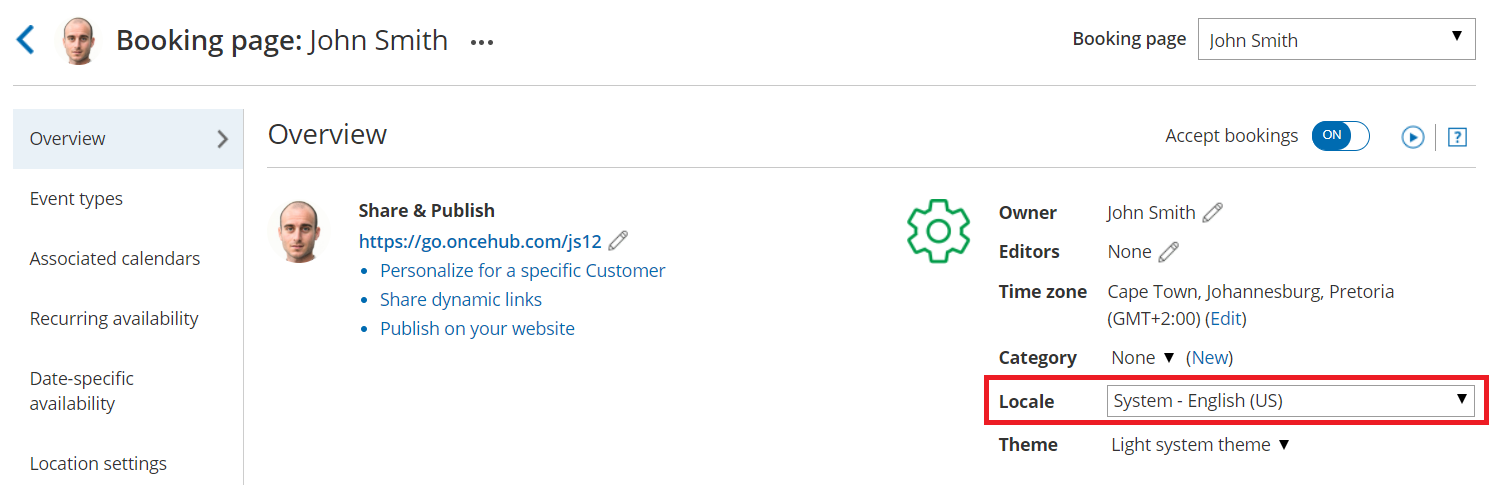 Figure 1: Booking page Overview section
NoteApplying a locale to a Master page always overrides the locales applied to any Booking pages included in that Master page.
Applying a locale to Customer notifications
Section titled “Applying a locale to Customer notifications”The locale of the Booking page or Master page determines the date/time formats and the language of the Dynamic fields in Customer notifications including outgoing emails, SMS messages, and the calendar event. The text in these notifications is automatically translated.
- Dynamic fields in notifications are only translated for Customer notifications based on Custom templates. Dynamic fields in User notifications and Default templates always remain in English.
- Static text is not automatically translated. To translate the static text of these notifications, you’ll need to use Custom notification templates.
Localization of Default notification templates vs. Custom notification templates
Section titled “Localization of Default notification templates vs. Custom notification templates”| Default templates | Custom templates | |
| User notifications by email and SMS | OnceHub Dynamic fields are shown in English. Date/time format follows User profile settings. | OnceHub Dynamic fields are shown in English. Date/time format follows User profile settings. |
| Customer notifications by email and SMS and the calendar event | OnceHub Dynamic fields are shown in English. Date/time format follows User profile settings. | OnceHub dynamic fields such as time zone, country, and location are shown in the locale selected on the Booking page. Date/time format follows locale settings. |
Setting a default locale
Section titled “Setting a default locale”The account’s default locale is set under the Localization editor. To set a locale as your default locale, select the desired locale from the locale list and then click Set as default locale at the top of the page (Figure 2).
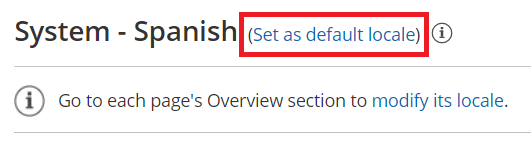 Figure 2: Set your default locale
The default locale will be automatically applied to any newly created page, but existing pages will not be affected.